
Armadillo
Type: Pavilion
Medium: Rhino + Grasshopper + Fologram + KUKA
Material: Marine-Grade Plywood
Year: 2025
Location: University of British Columbia, Vancouver, BC
Medium: Rhino + Grasshopper + Fologram + KUKA
Material: Marine-Grade Plywood
Year: 2025
Location: University of British Columbia, Vancouver, BC
The Concept
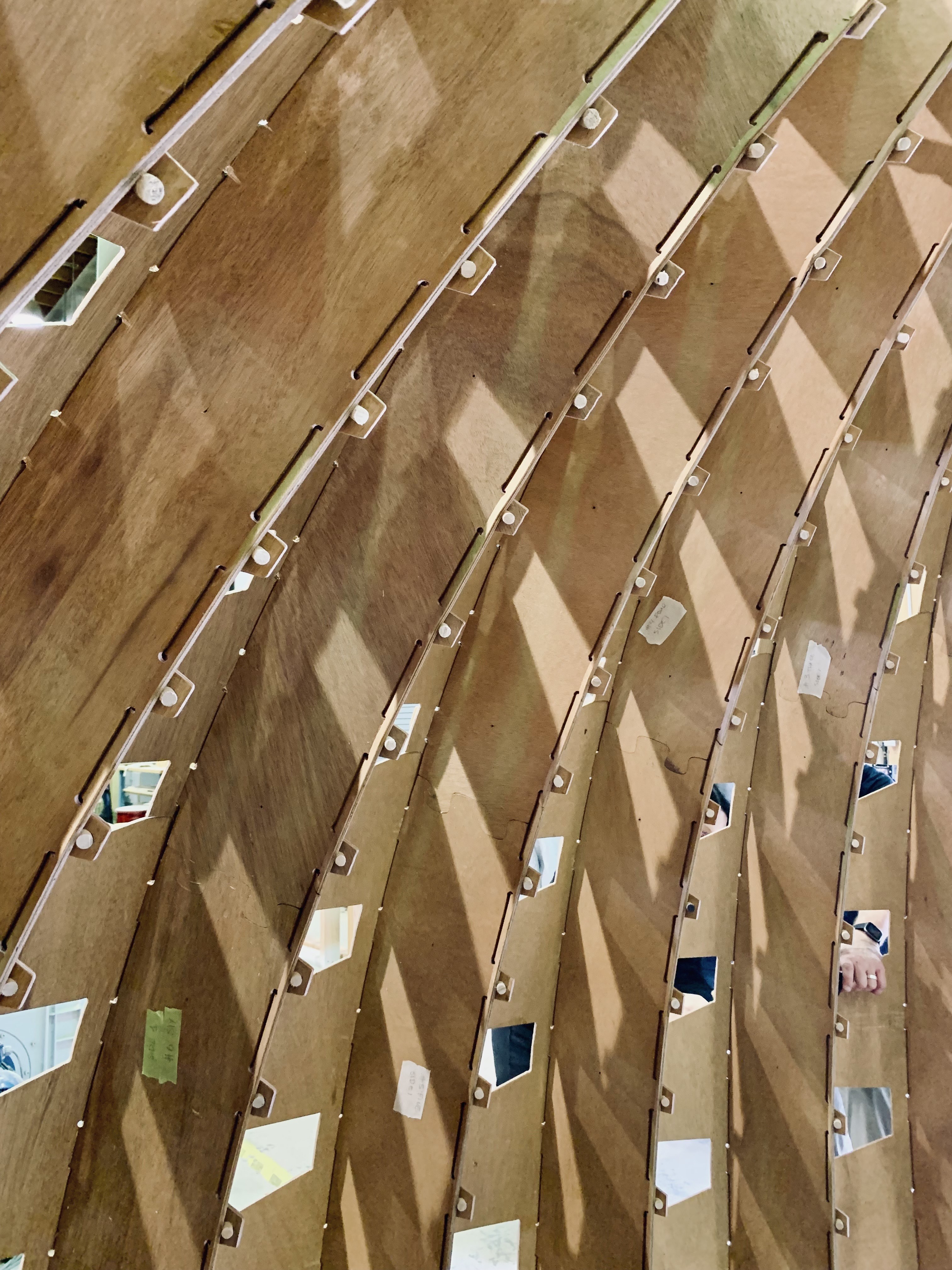
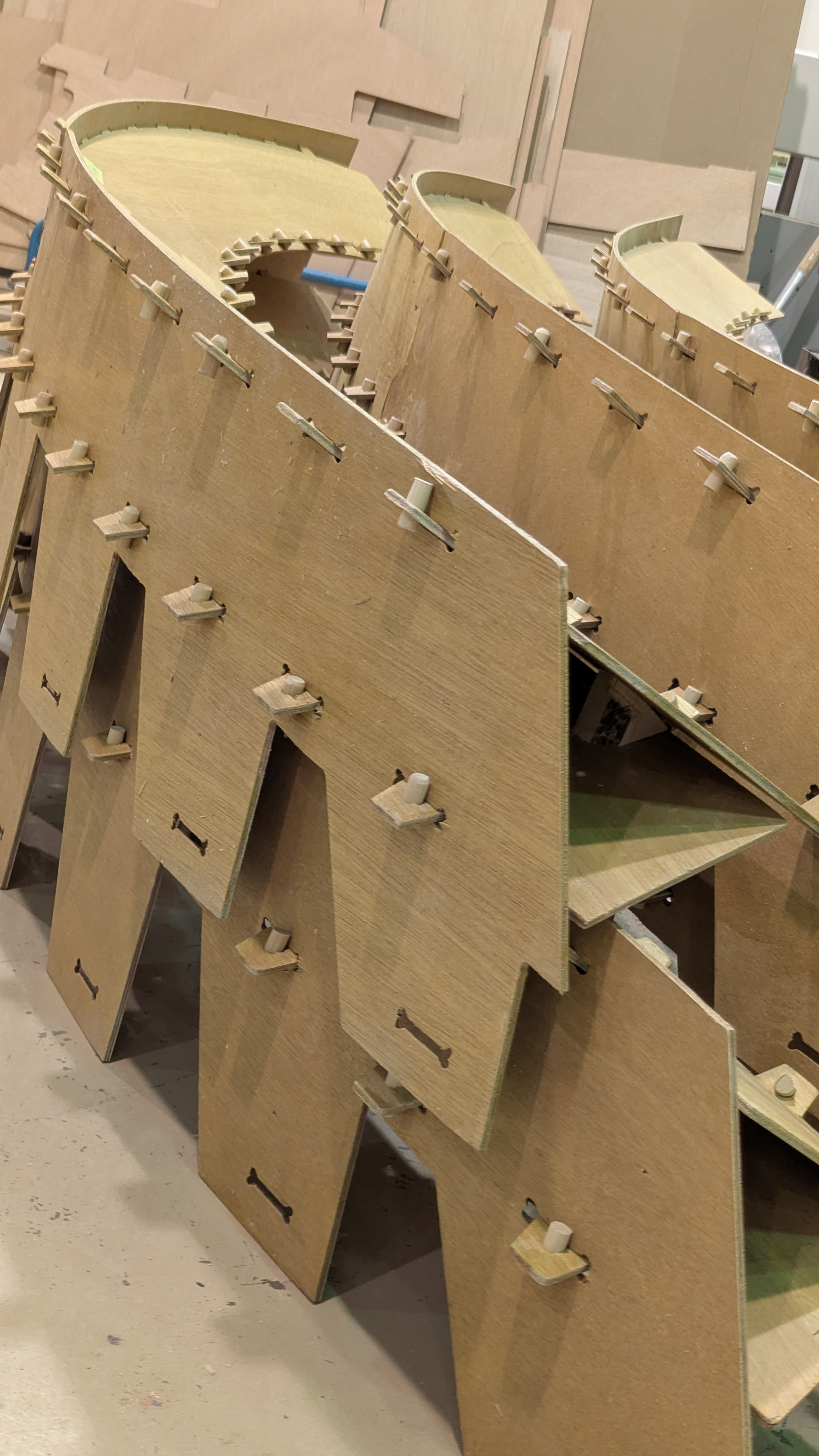
Armadillo explores the friction between rigid digital logic and the natural elasticity of wood. Instead of forcing timber into heavy rectilinear frames, the structure asks how a rigid material can flow. It acts as a component-based spatial environment that utilizes the inherent bending elasticity of flat plywood sheets. By actively tensioning the material, the design creates a doubly curved surface that feels organic but is entirely driven by precise geometric constraints. The project was developed and installed at the UBC campus as part of the 2025 Robot Made Workshop. It builds directly on the robotic timber fabrication research led by Associate Professor AnnaLisa Meyboom at UBC SALA.
The Computation
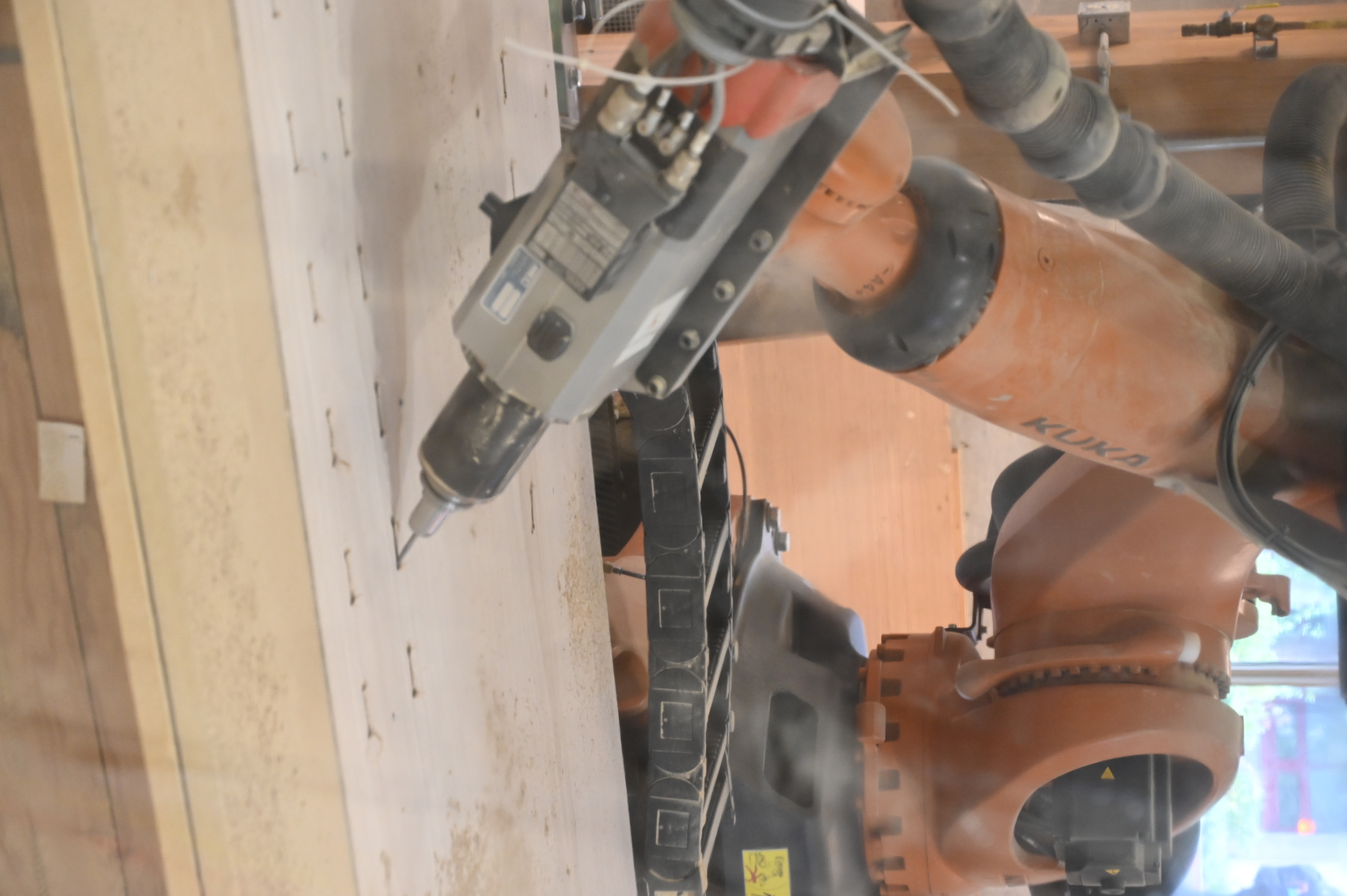
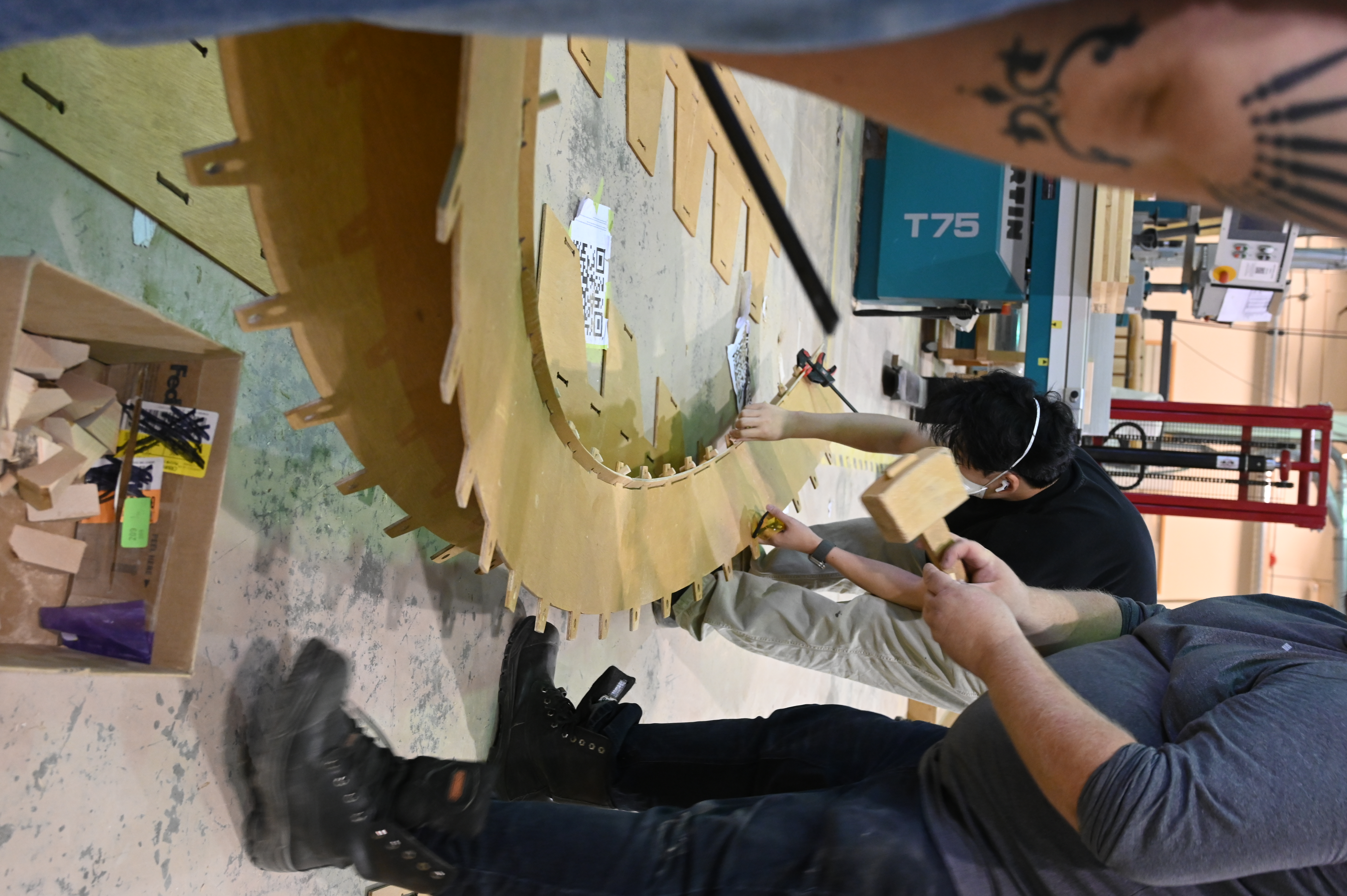
Ambitious doubly curved surfaces usually fail at the fabrication stage. To make this manufacturable, the entire workflow was scripted to bridge the gap between parametric design and physical constraints. The geometry was resolved using the finite element method in engineering to predict material behaviour under tension. To eliminate manual drafting errors and reduce production time, all custom timber components were nested and toolpathed directly from Grasshopper to a seven-axis industrial robot. Taking full advantage of the extended fabrication range of the multi-axis setup, large sections of plywood were custom-milled to precise tolerances. These prefabricated elements served as the primary substructure for off-the-shelf facade planks. The result is a stable, doubly curved building system that proves a direct design to production paradigm for advanced wood construction.
Project Credits
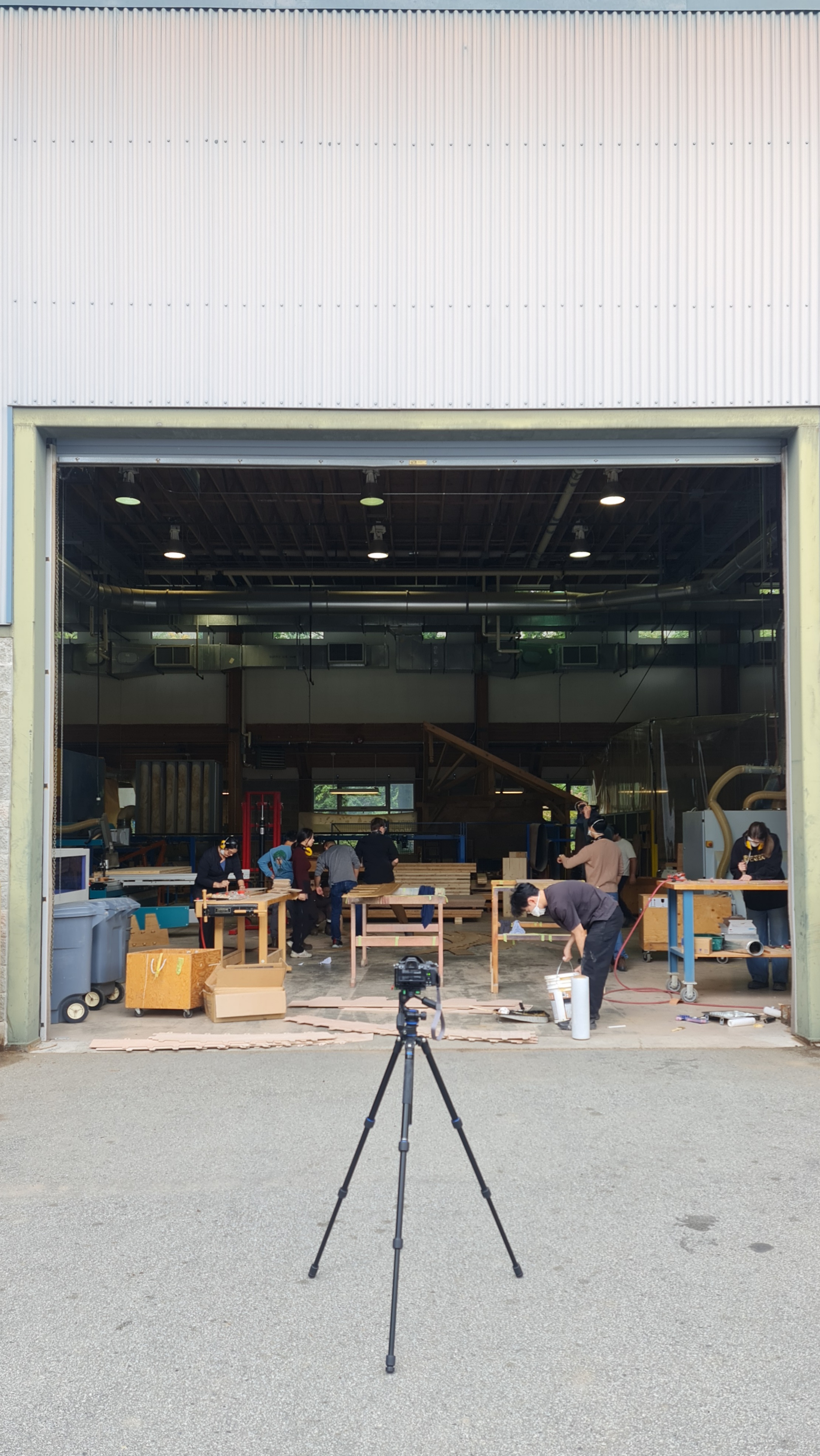
The workshop and fabrication were hosted at the UBC Centre for Advanced Wood Processing. It was completed in collaboration with Nicholas Hoban from the University of Toronto Daniels School of Architecture and Assistant Professor Aryan Rad from the University of Toronto Civil Engineering. Support for the initiative was provided by Forestry Innovation Investment.
Armadillo explores the friction between rigid digital logic and the natural elasticity of wood. Instead of forcing timber into heavy rectilinear frames, the structure asks how a rigid material can flow. It acts as a component-based spatial environment that utilizes the inherent bending elasticity of flat plywood sheets. By actively tensioning the material, the design creates a doubly curved surface that feels organic but is entirely driven by precise geometric constraints. The project was developed and installed at the UBC campus as part of the 2025 Robot Made Workshop. It builds directly on the robotic timber fabrication research led by Associate Professor AnnaLisa Meyboom at UBC SALA.
The Computation
Ambitious doubly curved surfaces usually fail at the fabrication stage. To make this manufacturable, the entire workflow was scripted to bridge the gap between parametric design and physical constraints. The geometry was resolved using the finite element method in engineering to predict material behaviour under tension. To eliminate manual drafting errors and reduce production time, all custom timber components were nested and toolpathed directly from Grasshopper to a seven-axis industrial robot. Taking full advantage of the extended fabrication range of the multi-axis setup, large sections of plywood were custom-milled to precise tolerances. These prefabricated elements served as the primary substructure for off-the-shelf facade planks. The result is a stable, doubly curved building system that proves a direct design to production paradigm for advanced wood construction.
Project Credits
The workshop and fabrication were hosted at the UBC Centre for Advanced Wood Processing. It was completed in collaboration with Nicholas Hoban from the University of Toronto Daniels School of Architecture and Assistant Professor Aryan Rad from the University of Toronto Civil Engineering. Support for the initiative was provided by Forestry Innovation Investment.